publications
publications by categories in reversed chronological order. generated by jekyll-scholar.
2026
-
 Robustness Analysis of Australia’s Internet Using a Multilayer Network ModelB. Lang, M. Roughan, and M. Ye2026, arXiv:2606.18737
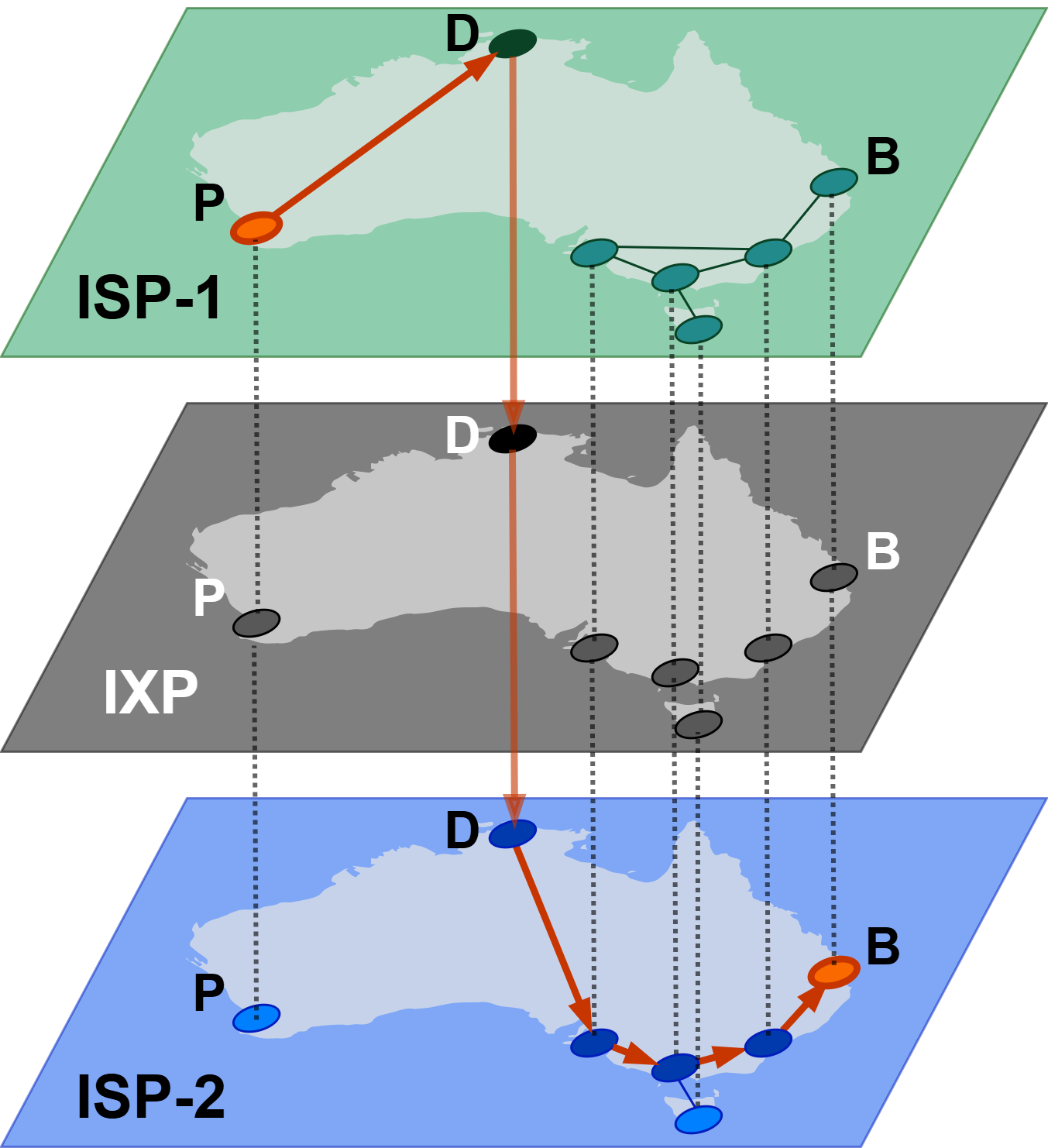
Australia depends on an Internet built from multiple networks of long-haul links. We study the interactions of these independent provider networks to investigate how the peering between these networks provides redundancy for failures on a single network, as well as the potential vulnerabilities introduced by failures of Shared Risk Link Groups (SRLGs), whereby ostensibly independent links of different providers fail simultaneously due to joint physical dependencies such as shared conduits. We introduce a generalised multilayer network model in which each layer represents the network of an individual Internet Service Provider (ISP), along with an Internet Exchange Point (IXP) layer that facilitates interconnections between ISP networks. We construct an Australia-specific model, consisting of six major ISPs. A failure analysis is performed on this network, revealing that diversity provides redundancy, even in the presence of shared risks, indicating the importance of a diverse network ecosystem.
@misc{lang2026robustnessanalysisaustraliasinternet,
  title = {Robustness Analysis of Australia's Internet Using a Multilayer Network Model},
  author = {Lang, B. and Roughan, M. and Ye, M.},
  year = {2026},
  archiveprefix = {arXiv},
  primaryclass = {cs.NI},
}
2024
-
 Investigating the Use of Electrodynamic Dust Shielding to Improve the Robustness of a Lunar Rover Drivetrain to RegolithH. Vine Hall, O. Mortier-Spole, V. Nguyen, and 4 more authorsIn Proceedings of the 19th International Conference on Intelligent Unmanned Systems, 2024
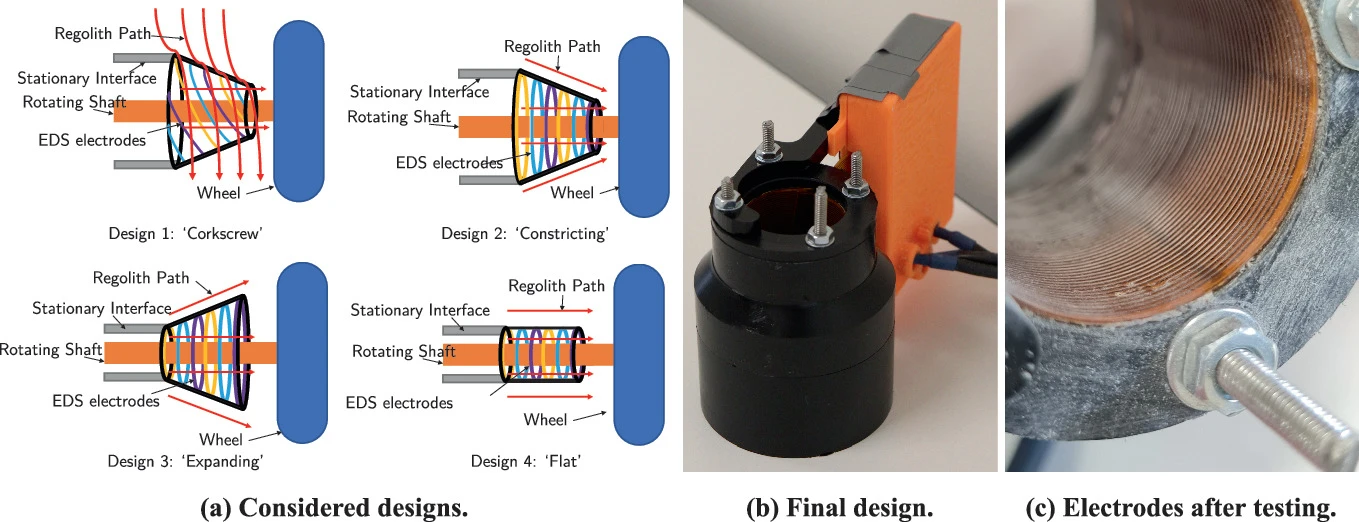
*Purpose* It is imperative for uncrewed and remotely operated lunar rovers to utilise active dust mitigation techniques, such as the electrodynamic dust shield (EDS), as it is not possible to manually clean such systems. The EDS may be used to reduce the volume of regolith incident on passive dust mitigation and dust tolerant designs for lunar rover drive systems, increasing rovers’ effectiveness and longevity that would otherwise be decreased by dust scattering and wear during operation. *Originality* Existing research into using an EDS for lunar regolith removal has primarily focused on flat topologies. This paper will outline how the EDS technology performs as a cylinder wrapped around a conductive vertical shaft, with three phases to control dust flow direction, thus extending the existing body of knowledge on this technology and investigating its use in this new and critical application. *Methodology* To allow comparison with existing research, an electrode pitch of 0.6 mm and a width of 0.3 mm was used in the EDS design. Testing was completed with LHS-1 simulant in both flat and vertical wrapped shaft configurations while powering the EDS electrodes at 1.3 kV and 10 Hz. *Findings* Testing found approximately 86.6% removal of simulant by mass (s.d. 9.5%) for flat panels and a 95.7% reduction in simulant passing through the seal interface for the vertical cylindrical configuration. Although this demonstrates promising simulant mitigation results that aligns with past literature, substantial future work is required to further improve the operational lifetime of the EDS and its viability in lunar mission environments.
@inproceedings{hall_investigating_2024,
  address = {Singapore},
  title = {Investigating the {Use} of {Electrodynamic} {Dust} {Shielding} to {Improve} the {Robustness} of a {Lunar} {Rover} {Drivetrain} to {Regolith}},
  isbn = {978-981-97-6591-1},
  booktitle = {Proceedings of the 19th {International} {Conference} on {Intelligent} {Unmanned} {Systems}},
  publisher = {Springer Nature Singapore},
  author = {Vine Hall, H. and Mortier-Spole, O. and Nguyen, V. and Lang, B. and Laden, M. and Munn, M. and Robertson, W.},
  editor = {Akmeliawati, Rini and Harvey, David and Sergiienko, Nataliia and Yang, Lung-Jieh and Park, Hoon Cheol},
  year = {2024},
  pages = {179--189},
}